

HR Payroll Compliance for Efficient Workforce Management for Companies

Table of Contents
- What is Payroll?
- What Is HR & Payroll Compliance?
- Key Components of HR and Payroll Outsourcing Systems
- Importance of the HR Payroll Services
- Benefits of HR Outsourcing and Payroll Processing Services
- The Role of an HR & Payroll System
- Payroll Processing & Management Services
- Why Payroll Compliance Matters
- The Modern HR’s Guide to PF, ESI, and Labour Code Compliance
- EPF Schemes 1952 & 1995: Everything Employers Must Know in 2026
- Final Thought
- Frequently Asked Questions
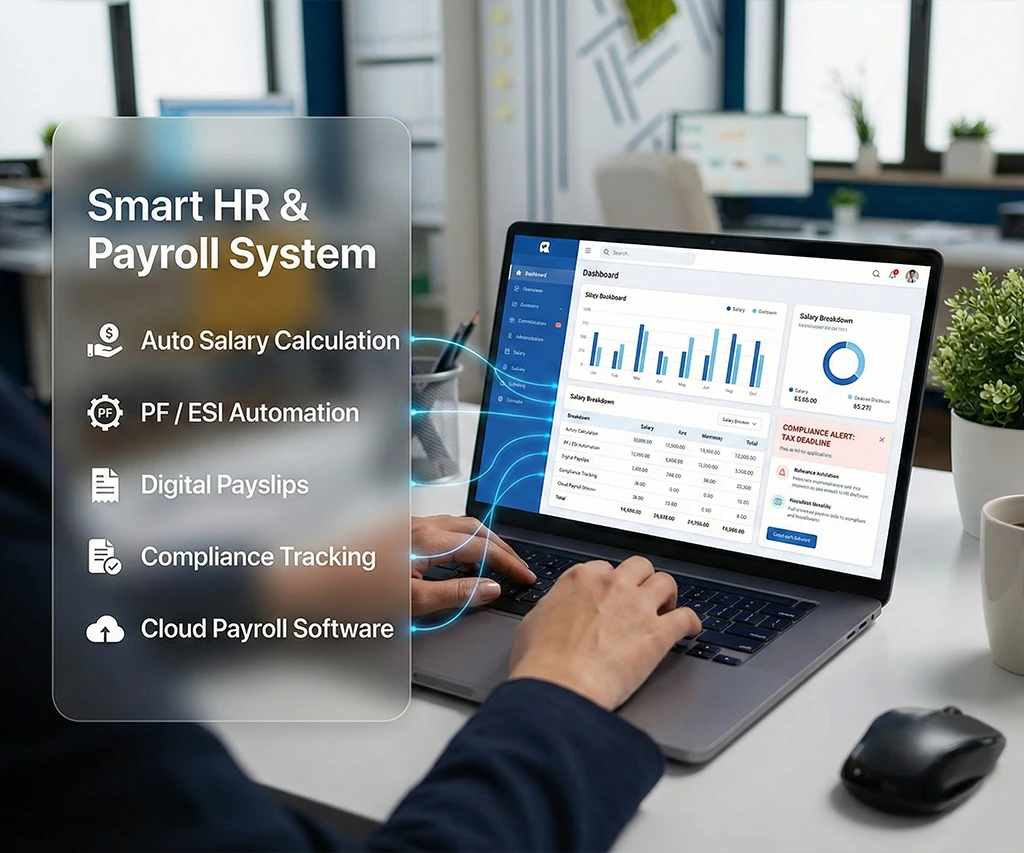
Companies looking for efficient workforce management solutions rely heavily on HR & payroll systems. Most companies often obtain humongous benefits from the HR and payroll management systems, HR payroll outsourcing, and HR payroll services to manage people and payroll accurately. A robust HR and payroll management system ensures transparency, workforce management, statutory compliance, tax calculations, etc., to reduce errors and maintain regulatory compliance.

What is Payroll?
Payroll refers to the process of calculating, administering, and disbursing employee compensation, which includes salaries, wages, incentives, bonuses, and all other forms of payment. The process requires total earnings calculation, tax deduction application, and compliance verification with government regulations. Therefore, an efficient HR and payroll outsourcing system is essential for maintaining the employees’ trust, legal compliance, and smooth business operations.
Companies in today’s digital workplace depend on HR and payroll systems or complete HR and payroll management systems to handle their employee record maintenance and calculation tasks while generating the required statutory reports. HR and payroll outsourcing services provide two benefits: essentially decrease manual errors and make salary processing more transparent.
What Is HR & Payroll Compliance?
Payroll compliance establishes the legal requirements that organizations must fulfill when they make employee payments and manage associated tax obligations, social security payments, and mandatory government documentation. The process involves much more than delivering payslips according to established timelines because the entire compensation system needs to comply with national, state, and local laws which protect organizations from financial penalties and legal consequences and government sanctions. The compliance process in India requires companies to fulfill multiple statutory obligations that include:- Provident Fund (PF) contributions according to the EPF Act.
- Employee State Insurance (ESI) contributions.
- Professional Tax (PT) deductions according to the rules when applicable.
- Tax Deducted at Source (TDS) calculations and complete required filings.
- Submission of state labor law documentation and performance of mandatory state-specific filings.
- Monthly, quarterly, and annual statutory filings and returns in accordance with regulatory requirements.
Key Components of HR and Payroll Outsourcing Systems
The payroll process requires proper structure through its essential components, which include:
- Salary Calculation: Basic pay, allowances, bonuses, overtime, and incentives.
- Deductions: Tax (TDS), Provident Fund (PF), ESI, professional tax, and other statutory deductions.
- Compliance Management: Adhering to labor laws and tax regulations.
- Payslip Generation: Detailed salary breakdown for employees.
- Reporting & Audit: Documentation for internal review and payroll compliance audit.
Businesses today use payroll processing software with their HR operations to streamline all HR tasks and operations for efficient management..
Importance of the HR Payroll Services
Payroll functions involve more than just salary payments. It also includes tax submission and mandatory deductions and contributions according to the legal requirements. HRPro is offering professional HR payroll solutions, helping companies avoid penalties, reduce risk, and maintain documentation.
Over the years, companies have transformed in several ways. One of those transformations is opting for HR and payroll outsourcing services. Outsourcing for HR activities lightens the company’s burden and enables the company’s management to focus on its core business activities. HRPro solution is one of the most reliable providers of HR outsourcing and payroll compliance services in Noida and beyond.
Benefits of HR Outsourcing and Payroll Processing Services
Choosing HRPro payroll or payroll management services in India provides multiple benefits to companies. By outsourcing the HR and payroll services,
- Companies reduce their operational expenses.
- The process of data entry results in more precise data output.
- Companies complete their legal or statutory reporting requirements on schedule.
- Companies use professional experts to handle all their compliance needs.
- Companies provide payroll services that can adjust to changing business requirements.
An established payroll outsourcing firm like HRPro delivers complete HR payroll services, which include automated payroll calculations and compliance monitoring.
The Role of an HR & Payroll System
An HR & payroll system establishes one centralized system for managing all human resource data, including employee records and payroll calculations, required tax deductions, employee benefits, and tax document submissions. The payroll processing companies produce payroll results that maintain exact and full disclosure while meeting current legal requirements because it eliminates the need for outdated spreadsheet methods and outdated software.
For example, automated payroll systems can:
- Use attendance and leave data to determine payroll amounts that need to be paid to employees.
- Automatically calculate all required statutory deductions, including PF, ESI, PT, and TDS, without any need for manual work.
- Create compliance reports that meet auditing standards.
- Keeps digital records of payslips and filing documents in a safe digital format.
- Enable employees to check their payslips, tax certificates, and additional documents.
A modern HR and payroll management system ensures that companies stay up-to-date with shifting legal requirements, protecting them from unnecessary penalties and lawsuits.
Payroll Processing & Management Services
Professional payroll management services streamline payroll management work, including attendance integration, tax computation, payslip generation, and reporting. The payroll processing companies in India and payroll processing providers deliver secure technological payroll processing solutions.
Businesses seeking reliable support can partner with a trusted payroll outsourcing expert in India or a certified payroll outsourcing service provider to manage end-to-end payroll operations.
Modern payroll processing software, together with HRPro payroll platforms enable better efficiency through their automation capabilities, cloud accessibility, and their ability to monitor compliance in real time.
Why Payroll Compliance Matters
- Legal and Financial Protection: Companies use payroll compliance to protect themselves from facing penalties, receiving legal notices, and suffering damage to their reputation. Companies can achieve statutory compliance and complete payroll audits through proper implementation of HR and payroll systems or by choosing a suitable HR payroll outsourcing partner. The professional payroll compliance services in Delhi NCR and Noida deliver accurate filing services, helping clients decrease their financial risk.
- Accuracy Through Automation: The advanced payroll processing software system uses automation to reduce calculation errors that occur during salary, TDS, PF, and ESI assessment. The leading payroll processing companies or payroll outsourcing firms in India, such as HRPro, together with their payroll processing providers, deliver accurate payroll management solutions. The system enhances operational efficiency while helping companies meet legal requirements and improve their payroll management operations across India.
- Operational Efficiency and Focus: A payroll outsourcing company or service provider offers complete payroll processing solutions throughout India. Companies can direct their resources toward growth while allowing HRPro, one of the HR outsourcing and payroll outsourcing service providers in India, to maintain compliance with changing labor and tax regulations.
- Scalability and Business Growth: As companies expand their operations, HR payroll solutions, together with HR payroll services, enable them to handle their growing workforce needs. Payroll outsourcing in India, such as HRPro, provides support for multiple location compliance through payroll compliance services. Companies achieve growth through expert payroll assistance, as they utilise HRPro payroll systems, which maintain accurate records and ensure compliance with legal requirements.
The Modern HR’s Guide to PF, ESI, and Labour Code Compliance
- HR has become the center of ensuring compliance and maintaining operational efficiency. Under the 2025-2026 Labour codes, the modern HR compliance requires the strict restructuring of employees’ salaries, digitising company records, and adhering to strict monthly deadlines for employees’ PF for 20+ employees and ESI for 10+ employees. Companies must balance statutory requirements with seamless payroll operations.
Core Compliance Pillars for 2026 HR & Payroll Management

Wage Code Implementation (2025)
The latest update on the wage code for employees across all companies indicates that companies must modify their compensation systems to meet the requirements of the new wage definition. Basic Salary and Dearness Allowance (DA) constitute at least 50% of the total Cost to Company (CTC) according to the new guidelines.
Additionally, employers must include all amounts above 50% of CTC in their wage calculations for determining mandatory contributions, which include Provident Fund (PF), Employee State Insurance (ESI), and gratuity payments.
Therefore, to automate the employees’ wage restructuring process while achieving statutory compliance and minimizing compliance-related risks, companies opt for advanced HR & payroll systems or HR and payroll management systems. To make things simpler, many companies have chosen to work with HR payroll service providers, such as HRPro solution, to handle this transition process.
Provident Fund Compliance – EPF Act, 1952
PF compliance stands as a compulsory requirement for businesses that maintain a workforce of 20 or more workers. Both the employer and the employee must contribute 12% each of wages according to the updated wage definition.
The main requirements include the following:
- All contributions need to be deposited within 15 days of the following month.
- The new 50% rule changes in wage structure will create a higher PF requirement for employers.
- All companies must establish proper digital recordkeeping systems.
Companies today depend more on payroll processing services, payroll compliance audits, and outsourced payroll services to achieve accurate payroll results and meet filing deadlines, and HRPro stands as one of the best options for HR and payroll outsourcing services in India.
ESI Compliance – ESI Act, 1948
Employee State Insurance (ESI) regulations apply to companies with 10 or more employees earning up to ₹21,000 per month.
Contribution structure:
- Employer needs to pay 3.25% of wages
- Employee needs to pay 0.75% of wages
The New rules indicate that a mandatory re-verification of employees’ contact details in the ESIC portal is required every six months through OTP authentication.
The use of reliable payroll processing software combined with professional payroll outsourcing services ensures companies handle complex statutory requirements with greater efficiency and maintain successful compliance.
Labour Code Reforms (2025/2026)
Fixed-Term Employment
All fixed-term employees must receive the equivalent benefits that permanent employees receive, along with their statutory rights and security benefits. The HRPro Payroll framework, together with its structured payroll solution system, provides companies with a method to enforce their policies.
Overtime & Working Hours
Companies’ standard working hours extend between 8-9 hours per day, which is up to 48 hours per week. Any employee working more than the scheduled time or overtime must be paid twice the normal hourly rate. Additionally, companies need to maintain digital records through the payroll management services for both attendance and overtime work to ensure compliance.
Women’s Safety & Workplace Compliance
Companies need to offer workplace facilities that meet POSH standards for their operational environment. To ensure employees’ safety and maintain audit compliance, companies opt for HR and payroll outsourcing services.
Compliance with PF, ESI, and Labour Code requirements now stands as a key business function that every company must handle through its strategic planning processes. Contemporary HR professionals need to acquire operational knowledge about regulations alongside their ability to manage payroll through technological solutions and expandable HR payroll systems.
Employers opted for HR and payroll outsourcing and payroll processing services in India from HRPro, gain several benefits such as protecting the company from legal penalties, handling workplace disputes, and preventing operational disturbances. This enables the companies to create a responsible, trusted, and safe environment for all their employees.
EPF Schemes 1952 & 1995: Everything Employers Must Know in 2026
The Employee Provident Fund (EPF) Schemes in India is currently changing, so companies in 2026 need to follow the required EPF regulations. The two key pillars are the EPF Scheme, 1952, and the EPS Scheme, 1995, both governed under the Employees’ Provident Funds and Miscellaneous Provisions Act, 1952, and administered by the Employees’ Provident Fund Organisation (EPFO).
The guide provides essential information that every employer needs to understand about contributions, compliance requirements, pension liability calculations, and audit risk assessment.
Employees’ Provident Fund EPF Scheme 1952
The Employees’ Provident Fund EPF Scheme 1952 requires employees from qualifying businesses to save money for their retirement.
In 2026, the regulations require:
- Companies that employ 20 or more workers must comply with the EPF Scheme, 1952, rule.
- Companies are to voluntarily register for their operations.
- All workers who earn monthly salaries below ₹15,000 to receive mandatory coverage.
- Employees who earn above the wage threshold for mandatory coverage can choose to make their own contributions.
- Both the employer and employee will have to contribute 12% (3.67% EPF, 8.33% EPS).
The retirement package provides a lump sum payment, which includes interest and allows for partial withdrawals to cover expenses related to housing, marriage, and medical needs.
The following schemes protect EPF 1952 (Provident Fund), EPS 1995 (Pension), and EDLI 1976 (Insurance).
Employees’ Provident Fund (EPF) Scheme, 1995
The EPF Scheme 1995 establishes the social security system for India through the EPF and MP Act 1952, which the Employees Provident Fund Organisation EPFO operates. The system manages retirement benefits through funds that both employees and employers contribute to.
Key Features:
- Both employee and employer contribute 12% of wages (basic + DA); employer’s 8.33% goes to the Employees’ Pension Scheme (EPS).
- The system applies to all businesses that employ 20 or more workers whose salaries do not exceed ₹15,000 per month.
- The system gives retirement pension benefits, plus disability benefits and family pension rights for designated recipients.
- The system operates together with both the EPF Provident Fund and EDLI Insurance programs.
The program provides permanent retirement protection, which works in conjunction with existing social security programs.
Common EPF Compliance Risks in 2026
The accurate digital records, regular internal audits, and proactive compliance systems can significantly reduce risks such as:
- Incorrect wage classification
- Missed ECR deadlines
- Inaccurate EPS diversion
- Non-enrollment of eligible employees
- Failure to handle exits properly
To reduce the EPF compliance risk in 2026, companies will implement payroll compliance audits together with payroll processing services in India and their professional payroll outsourcing partner, like HRPro.

Final Thought
In 2026, the EPF Schemes 1952 and 1995 serve as operational requirements that companies use to manage employee benefits and maintain their corporate reputation.
Employers need to focus on three main requirements when they use either advanced HR and payroll management systems, payroll processing software, or HR payroll services providers.
Employers need to achieve three basic requirements, which include:
- Accurate statutory contributions
- Timely filing of required forms
- Transparent reporting
- Efficient pension management
Companies need to maintain continuous compliance with EPF and EPS requirements because it helps them avoid penalties and develop employees for future requirements. Additionally, they use a professional payroll compliance audit through payroll and HR outsourcing companies like HRPro to manage their workforce while making it easier to follow regulatory requirements.
Questions People Commonly Ask
HR payroll compliance requires companies to follow mandatory regulations that govern salary payments, tax withholdings, Provident Fund, Employee State Insurance, gratuity, bonus payments, and labor law requirements. The system makes sure companies fulfill their responsibilities, which exist under the Employees’ Provident Funds and Miscellaneous Provisions Act of 1952, the Employees’ State Insurance Act of 1948, and the Code on Social Security of 2020.
The implementation of an effective HR and payroll system, together with a partnership to professional HR payroll services, delivers accurate management of statutory requirements.
The present-day HR and payroll system exists to automate multiple functions, which include salary calculation, PF deduction, ESI deduction, TDS computation, statutory filing, and compliance alert generation. The advanced payroll processing software system eliminates human errors while delivering essential functions that help in managing employee productivity throughout the entire workforce management process.
Professional payroll processing services or payroll processing services in India ensure:
- Scheduled payment of salaries
- Precise computation of taxes
- Automatic execution of legal requirements
- Immediate availability of payroll information
The leading payroll processing companies, together with the payroll processing providers, use cloud-based systems to execute their payroll management operations.
Established HR and payroll service providers typically offer:
- In-depth regulatory expertise
- Automated compliance monitoring and tracking
- Minimized risk of penalties and non-compliance
- Secure handling and protection of payroll data
- Dedicated payroll support services
Numerous companies choose to use professional HR and payroll systems to manage their workforce while making it easier to follow regulatory requirements.